
Today, I want to consider the Fossil Fuel and Electric Vehicles from a technical, environmental, drivers and future use world wide point of view.
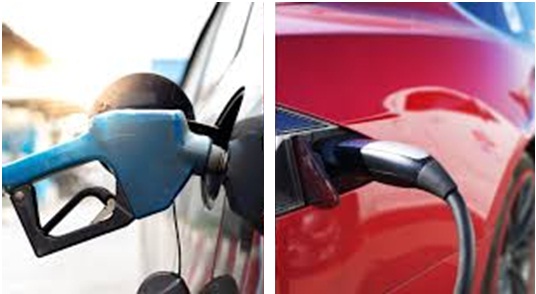
Technical Point of View
Internal Combustion Engine Vehicle (Car)
The first modern Internal Combustion Engine (ICE) was created by Nicolaus Otto 1867 known as the Otto ICE. The ICE is a Machine that requires Fossil Fuel (Petrol, Diesel and Lubrication Oil) to operate. In the case of an ICE, Combustion is a chemical reaction between, pressurised oxygen and fuel known as the Fuel/Air mixture and when subjected to an electrical spark causes a mini explosion known as Combustion which produces Power and Heat. The ICE can be a 2 stroke or 4 stroke engine which operate in a similar manner.
The basic operation of a 4 stroke ICE is as follows; refer to the image below: To produce Power and Rotation to the Vehicle Gear Box, the Piston moves Up and Down in the Cylinder and via the Connecting Rod, Rotates the Crankshaft which is connected to the Gearbox and Clutch mechanism. To achieve this when the ICE moves with 4 Strokes as follows: (1; Intake Stroke) As the Piston starts to move to the Bottom of the Cylinder the Fuel/Air mixture is allowed in via the Fuel Inlet Valve. (2; Compression Stroke) As this is happening the Piston moves up to the Top of the Cylinder, Compressing (Pressurising) the Fuel/Air mixture. (3; Combustion Stroke) As this occurs a Spark from the Spark Plug ignites the Fuel /Air mixture causing the Combustion. This forces the Piston Down to the bottom of the Cylinder producing the Crankshaft Rotation. (4; Exhaust Stroke) The residue Gas from the Combustion is ejected via the Exhaust Outlet Valve as the Piston starts to move up to the Top of the Cylinder and the Cycle starts all over again.
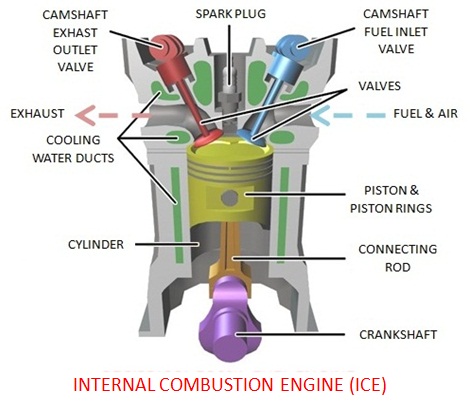
The image below is a modern Fuel Injection ICE which totally Computer Controlled which adjusts the Fuel/Air intake and complete timing of the ICE Components for maximum efficiency which reduces the amount of Exhaust Gasses (Carbon Dioxide CO2) transmitted into the Environment. This ICE is connected to the Automatic Transmission and the Front Wheels which also referred to as the Power Unit & Transmission.

Electric Vehicle (Car)
Most people think that Electric Vehicles (EV’s) are a new technology which is far from the truth. Thomas Parker built the first EV production Car in 1884 in England. However, over a period of time many others were produced by the USA and France. However, they all had the same problem in that, the Battery and Motor Technology in those days was in its infancy, therefore the Power produced was comparatively low which could only give a short range before Recharging the Battery.
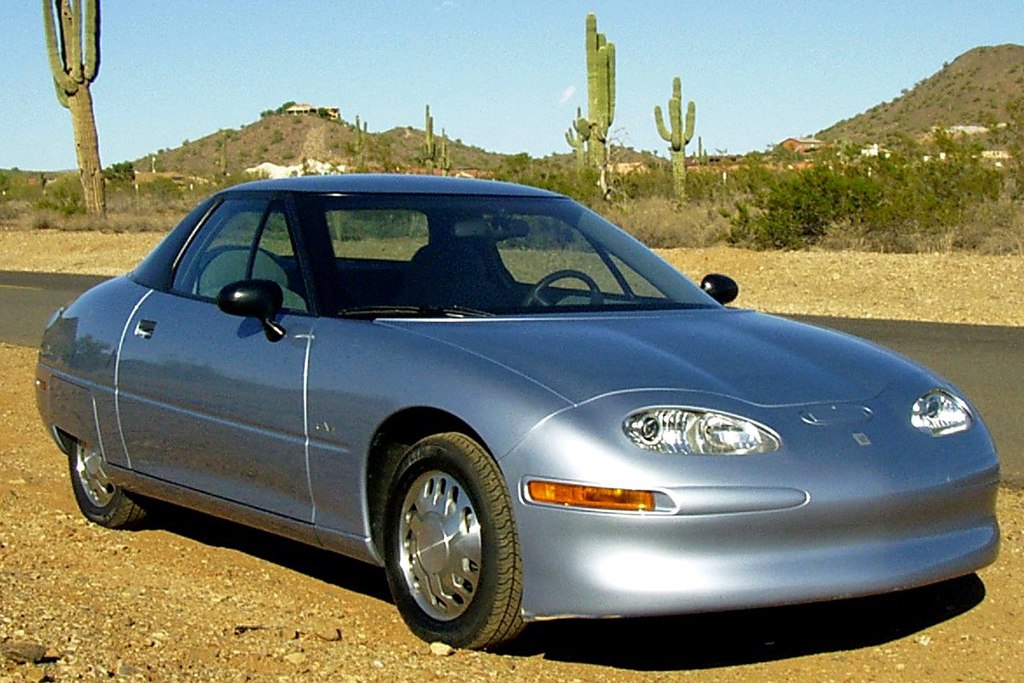
Since the early 1990’s the concerns of Global Warming and a world Fossil Fuel Crisis, gave an opportunity to apply ‘Green Technology’. The first modern EV car was the USA General Motors EV1 which was mass-produced after its debut in 1996 but only lasted until 1999. The original EV1 had 32 Lead-Acid Rechargeable Batteries, with an Electronic Drive System, that produce a Range of 70-100 miles on a Single Charge. Later models had Nickel-Metal Hydride Batteries (NiMH) that gave a Range of 120-140 miles on a Single charge that took 6 to 8 Hours. The EV1 had one 3 Phase AC Electric Motor with a Single Reduction Unit to the Drive Wheels. However, General Motors decided that commercially the EV1 was not viable and stopped production in 1999.
Today’s EV’s are dominated by TESLA a USA Company and BYD a Chinese Company, However, many of the major Fossil Fuel Car manufactures are also increasingly producing EV’s. In all of these cases the principle of driving the Front and or the Rear Wheels through a Drive System, using an Electric Motor or Motors (Power Unit & Transmission) energised by a Large Battery, is the same. However, the technology is evolving very fast in both Power Unit & Transmission and especially the Batteries. It is the Battery Technology which is enabling very Fast Speeds and Long Ranges well over 500 miles on one Charge which has also been significantly reduce in time. The main Battery Technologies are the Lithium-Ion Manganese Cobalt Oxides (Li-NMC), Lithium-Iron Phosphate (LFP) Blade Battery and the latest, the Solid State Battery being developed by BYD and others.

Power Unit & Transmission Comparison Summary
Both the latest Fossil Fuel and Electric Vehicles a Power Unit & Transmission (PU&T) are designed for the same purpose to Drive the Car Road Wheels. Both are reasonably Complex and Electronically Controlled.
The Fossil Fuel PU&T has many more moving components such as Pistons, Valves, Camshaft, etc which require a Oil Lubrication system ; that are subject to friction resulting in wear. Due to the Combustion, produces Heat, Exhaust Gas and Noise. Most Power Units have to have a complex Liquid Cooling System to dissipate the Heat.
The Electric Vehicles PU&T still has moving components but related to the Electric Motor which a very limited amount of friction and wear. There is no Combustion therefore there is no Exhaust Gas, less Heat and very little Noise. However, there is either and Air Cooling System and/or a Liquid Cooling System to dissipate the Heat especially from the Battery.
The most Consequential Difference is that the Electric Vehicles PU&T does not produce Exhaust Gas (CO2) like the Fossil Fuel PU&T which affects the Atmosphere. The other Marked Difference is the Electric Vehicles PU&T is very Quiet.
Environmental Effects
It has been established that the creation of Carbon Dioxide CO2 from many sources including Fossil Fuel Vehicles including Cars is affecting the Earths Climate and Overall Temperature. There are many new Technologies evolving to overcome this problem including the Electric Vehicles (EV’s). As a side advantage there is another form of Pollution that is not normally highlighted which is Noise. The Electric Vehicles (EV’s) also addresses this problem.
Driver Experience
My experience driving Fossil Fuel Vehicles including many types of Cars spans over 60 years. However, for my Driving Experience Comparison, I have chosen my 2006 Honda Accord 2.4L which I have had since new and my friends 2022 BYD Atto3 which I have driven many times.
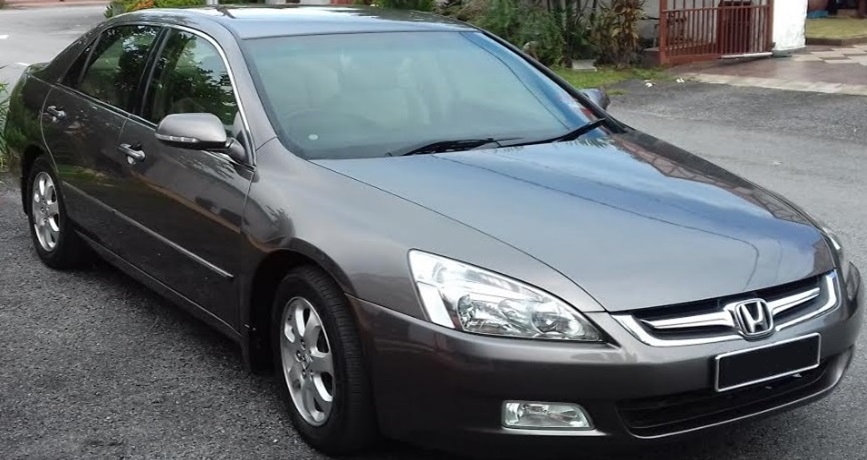

Honda Accord 2.4L
My Honda accord 2.4L is a large high quality family car that has a high performance Power Unit & Automatic Transmission. It can accelerate from 0 to 60 mph (100 Km/h) in 9,5 seconds. Its Fuel Consumption averages at 30 mpg. It is reasonably quiet with very good sound installation. However, there is still engine noise and slight vibration which all Fossil Fuel Engines experience, especially when first starting the car. Its general overall performance is very good. As an experienced driver the sound and feeling driving this car can be exhilarating and a pleasure.
BYD Atto3
The BYD Atto3 is a completely different Driving Experience. The Controls are the same as the Honda Accord. However, right from pressing the Start Button on the BYD Atto3 there is no noise. The drive selector is only a small unit and when the accelerator pedal is pressed again no noise except for the tyre noise. The Atto3 can accelerate from 0 to 60mph in 7.9 seconds. When driving and accelerating the BYD atto3 is extremely responsive to a point where you have to be careful as there is no real feedback noise like a Fossil Fuel Car. However, after driving the BYD Atto3 several times you become accustomed to this situation. As a relatively new driver of an Electric Vehicle the feeling driving this car can be exhilarating and a pleasure, especially the significant reduction in noise levels.
Fuel and Power Infrastructure
We are all familiar with the Fossil Fuel Infrastructure which is universal and adequate for filling up the car with ease at many Service Stations that have been created over the years. This allows us to travel almost anywhere knowing that Fuel is available when we need it

The Electrical Power Infrastructure for charging Electrical Vehicles (EV’s) is still in its infancy (bottom left). That being the case there is a great deal of fear in the public that buying an EV may not be as convenient as a Fossil Fuel Car. Some of this fear can be reduced by having a Home Charging Unit (bottom right) allowing unlimited travel close to home. Some of this hesitancy is being addressed by the manufactures improving the Battery Technology as we have seen to extend the EV Range on a single Charge. They are also decreasing the time it takes to Charge the EV Battery. As time goes on and more EV’s are used the Power Charging Infrastructure will improve.
Future of the Electrical Vehicles
At present the expansion of Electric Vehicle including Cars is reasonably slow but increasing especially in China and Europe with the USA cautiously moving forward but with many still wanting Fossil Fuel Cars and the USA Government pushing to drill for more Oil and Gas. Surprisingly, Norway has the highest number of Electric Vehicles 95% of all Vehicles. One of the biggest threats to the complete move to Electrical Vehicles comes from the Oil and Gas producing Countries who rely upon these Fossil Fuels for their income. Another important issue is the Generation of Electric Power to a Level required to sustain the total conversion to Electrical Vehicles. It is also very true that to Generate Electric Power most Power Generation Stations use Fossil Fuels, Coal, Oil and Gas. Therefore for the foreseeable future, even with the expansion of Electric Vehicles, the world will still be using Fossil Fuels for Vehicles and Energy production.
My Conclusion
Whilst I have had some extremely high quality and powerful motor cars such as the BMW 750iL which was the ultimate driving machine and of course my Honda Accord 2.4L which I have thoroughly enjoyed driving, I have to say the BYD Atto3 Driving Experience impressed me very much due to Smoothness, Quietness and Responsiveness. Therefore, I do see the demand for Electric Vehicles rapidly expanding given that the Infrastructure to Support them is available.
 <a href="https://astra283.wordpress.com/wp-admin/site-editor.php?calypsoify=1&block-editor=1&frame-nonce=af705db4bc&origin=https%3A%2F%2Fwordpress.com&environment-id=production&support_user&_support_token&postType=wp_template&postId=pub%2Flivro%2F%2Fhome#site-title-pseudo-link">Training designer</a> - avionic & Aircraft Engineer -- BRYAN HOGGb.e.m